
Someone on your team hears about Hermes Agent or Paperclip and wants to try it this week. Neither is Claude Code, Codex or OpenCode, so the company's accounts do not reach them.
To try one, they paste an API key into the app's config. That key spends outside every limit you set, and the app's usage belongs to a key rather than to a person. Its prompts skip the secret scanning that the rest of the team's requests go through. Nobody at the company has read what the install script did on that laptop, either.
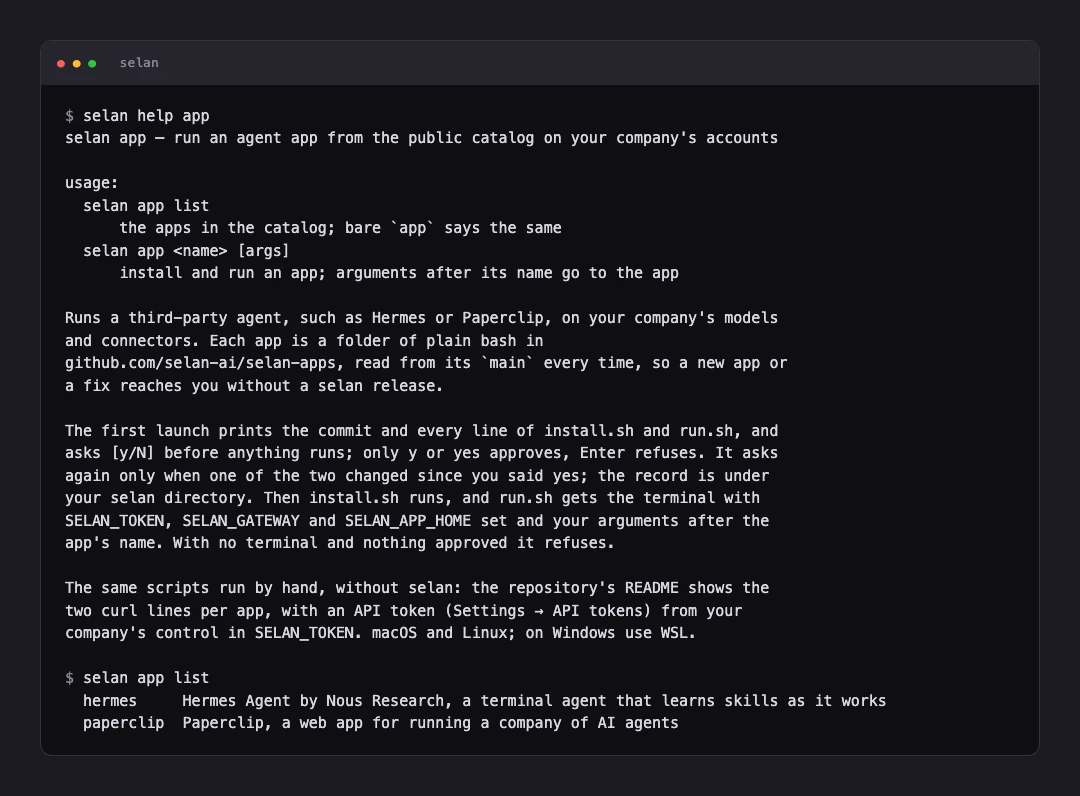
Selan 1.25.0 adds selan app. It installs an agent app from a public catalog and starts it on your own Selan session, so it uses your company's models and the rules that already apply to Claude Code. The first two apps are Hermes Agent, from Nous Research, and Paperclip, an open-source app for running a company of AI agents.
Run it
selan update
selan app list
selan app hermes chat
The catalog is github.com/selan-ai/selan-apps, read at main as one tarball each time. Before anything runs, Selan prints the commit and every line of the app's install.sh and run.sh, and asks [y/N]. Only y approves, and Enter refuses. It asks again whenever either script has changed since you approved it.
Then it installs the app into ~/.selan/apps/<name> and runs it with your session. Everything after the app's name goes to the app, so selan app hermes chat -q "hello" asks one question. Paperclip is selan app paperclip, and it opens at http://127.0.0.1:3100.
The scripts are bash, so selan app runs on macOS and Linux. On Windows it refuses; use WSL.
What each app gets
Both apps talk to Selan's gateway in the Anthropic Messages format, so your company's models, spend limits and secret scanning apply, and usage is counted to the person who ran it. Nothing had to change in the gateway for this.
Hermes gets your company's models, its MCP connectors, and the skills from its plugin marketplaces. Each launch writes Hermes's configuration again from what your company has switched on, so a change reaches the next launch.
Paperclip gets a "Selan" AI connection with your company's models. Its Claude Code agents use that connection, with no Claude login.
Without the selan CLI
An owner creates an API token under Settings → API tokens. Then the two apps are two lines each, and the scripts are the same ones selan app shows you:
export SELAN_TOKEN=selanct_...
curl -fsSL https://raw.githubusercontent.com/selan-ai/selan-apps/main/hermes/install.sh | bash
~/.selan/apps/hermes/run.sh chat
Read the script before you pipe it.
A new app is a pull request
Each app is a folder with an install.sh, a run.sh and a README, listed in the catalog's catalog.json. A new app reaches everyone through a pull request to that repository, with no CLI release. The scripts write only under the app's own folder, and the token stays out of files unless the app has to keep a key itself.
On a server
The same repository is a Claude Code plugin. Add it with /plugin marketplace add selan-ai/selan-apps and /plugin install selan-apps@selan-apps, then ask Claude to deploy an app. Its skills are:
deploy-local, which can also run an app as an always-on service on your machine.deploy-google-cloud, which makes a VM in your project and runs the app as a systemd service. You reach it over SSH through IAP, so no port is open, and the token sits in Secret Manager.deploy-hostinger, for a VPS you already have. It is written from Hostinger's documentation and has not yet been run against a real one.
A server has no session, so it needs a token that lasts. You paste it into a line that hides it, and it goes straight to its destination. Claude never sees it.
What does not work yet
A Claude model served from a Claude subscription gets no answer in Hermes Agent, which shows Anthropic's HTTP 400 that third-party apps now draw from extra usage. It works in Paperclip's agents, which are Claude Code itself. Every other model in your catalog answers in both.
Paperclip keeps your token as the key of its connection, in its own database, because it stores connections itself. On a server its page stays on localhost behind an SSH tunnel.
How each one is set up is on the docs pages for apps, Hermes Agent and Paperclip.